

Tidewrack
Nine floors down, three seal-stones hold the sea out of a drowned city. Lift one and the water starts coming in behind you. Lift all three and it comes in fast.
Then everything you learned on the way down runs backwards. The corridors you walked are filling from the bottom. Your lantern goes out the moment your head goes under, unless you found something to hood it with. The heavy armour that kept you alive is now the reason you cannot swim. And the rats that chased you through the dark are drowning, while the things that were waiting in the sumps come up to meet you.
You choose how much of that you want. One stone is a long walk out. Three is an emergency, and it is the only ending that is worth anything.
Who goes down there
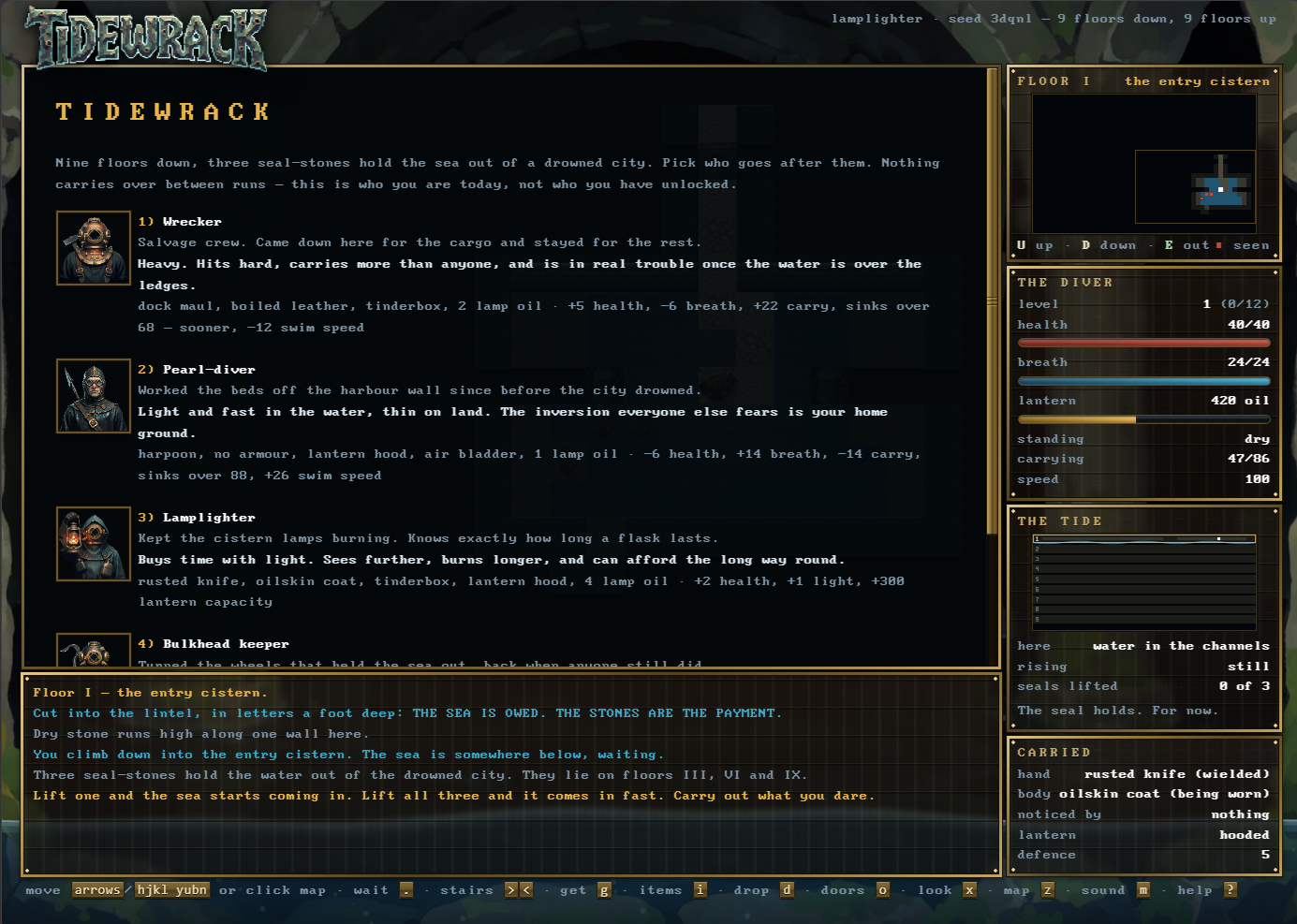
Four divers, picked at the start of every run. Not unlocks — this is who you are today.
The wrecker hits hard, carries more than anyone, and is in real trouble the moment the water is over the ledges. The pearl-diver is thin on land and fast in the water: the inversion everyone else fears is her home ground. The lamplighter buys time with light — sees further, burns longer, can afford the long way round. The bulkhead keeper plays the terrain rather than the clock, and knows where every watertight door is the moment you arrive.
They are not tiers. They are four different relationships with the same four clocks.
Four clocks, and they all wind each other
Oil. The lantern burns a unit every turn. Lit, you see six tiles. Unlit, you see what you can touch. Go under and it drowns, and soaked tinder will not relight it — so a lantern hood is worth more than it looks.
Breath. Two dozen turns under water, then you start drowning. A pale lamprey does not drain your health — it drains your breath.
Weight. Carry too much and you do not swim at all. You sink, walk the bottom at a crawl, and drown twice as fast. The anchor plate is the best armour in the wrack, and if it is cursed you will never take it off again.
The tide. It rises from the bottom floor upward, it accelerates the longer the breach stays open, and every stone you lift multiplies the rate. Get moving.
The water is not a number
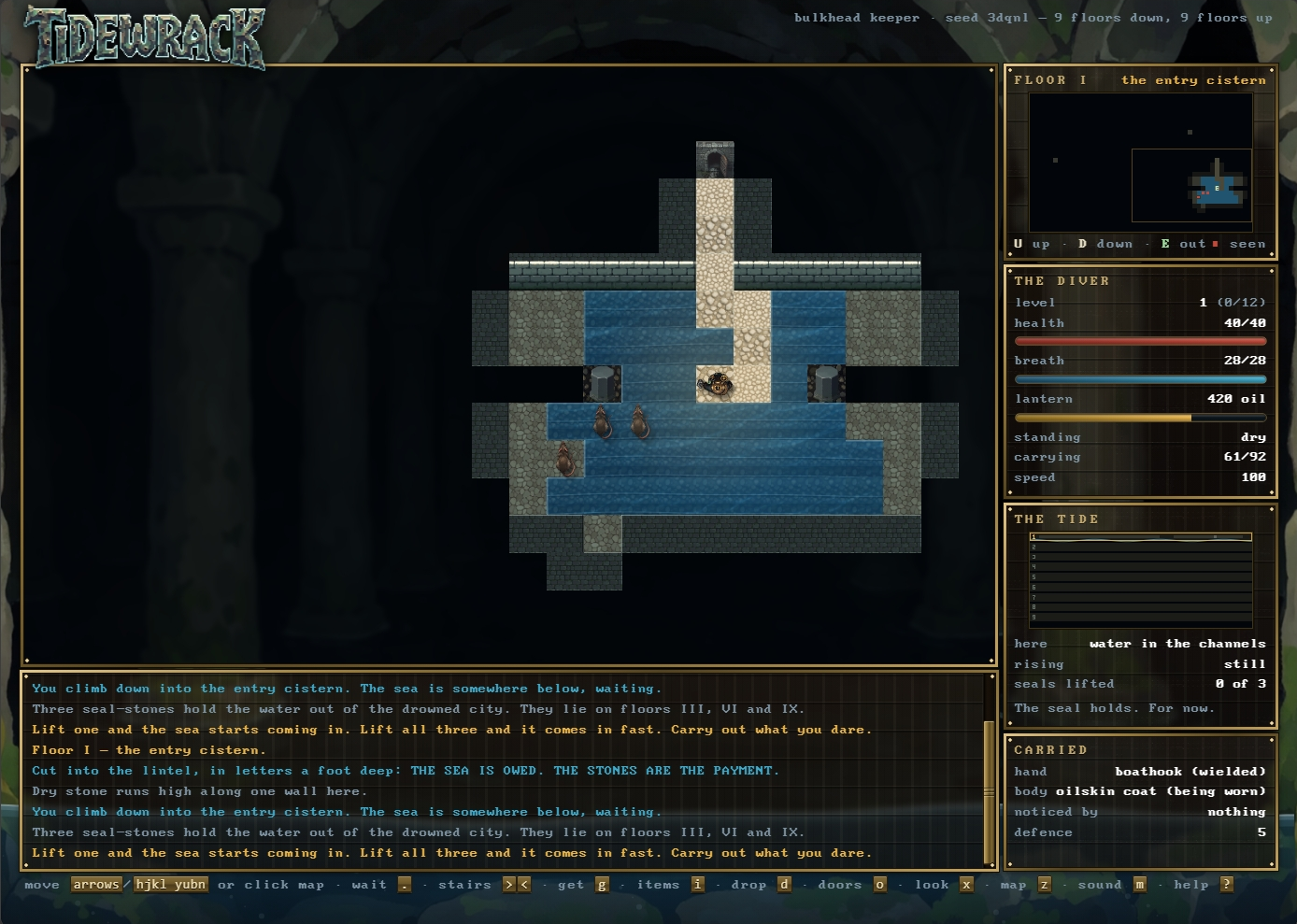
Every tile has a height — sump channel, floor, ledge, platform — and the flood fills by connectivity, not by a global waterline. A shut bulkhead keeps a room bone dry with the sea on the other side, so sealing one behind you buys the ground you are standing on and strands whatever was swimming after you. Every floor generates a high route that stays walkable long after the obvious way is a swim. Reading the height of a room, not just its walls, is the skill the game is about.
And in the pump works there is a lever that slows the tide across the whole wrack. It is always a detour. It is always worth thinking about.
The bestiary changes sides
Every creature has two speeds, one for air and one for water.
You are fast on dry stone and slow in the water. Cistern rats are faster than you on stone and flounder helplessly once it floods. Needle eels are lethal in water and cannot leave it. Toadman hunters will put a tongue round your chest and drag you off a dry ledge into the deep. Gulpers swallow you and pull you down. Ironback crabs plug a corridor and simply do not care. Deeper down there are things that were never anybody's idea of a fish.
So the flood does not just add a hazard. It swaps the entire threat profile out from under you, halfway through the run.
Things worth knowing
Fire on water. Lamp oil floats. Pour a flask onto the water you are standing in and it spreads across that pool, stopping exactly where the water stops — so a shut bulkhead is a firebreak. It will not light itself. Strike the tinderbox at the edge and the fire runs away from you across the surface and cooks everything floating in it, which includes you if you did not step out first.
Salt eats everything. Armour and weapons wear as you use them, faster in the water and faster still on the deep floors. A sound blade is not the same blade as a scarred one. That oilskin coat on the floor is not a duplicate of yours — it is a fresh one.
Coat the blade. Acid on a weapon adds bite and costs condition. It is a decision about the next three fights, not a free upgrade.
Venom. Two things down there carry it. It needs curing, and if you have no cure it will eat your healing draughts instead. You can see it on you: spores circling while it is still in your blood.
Go dark. Most things are asleep when you arrive, and the lantern is what wakes them. Striking a sleeper is worth far more than a fair fight. Light is a choice, not a setting — and rooms have pillars and wall alcoves, so the thing you cannot see is not always asleep.
Wrecks. Most floors have a hull walled off behind a shut bulkhead. That is where the good gear is.
Traditional, as the jam asks
Turn-based. One character. Permadeath. Run-based with no meta-progression — no unlocks, no carry-over, nothing saved between runs. Procedurally generated floors where the generation is load-bearing rather than decorative: elevation, flood regions, watertight divisions, a high route, a wreck, pillars and alcoves that break a room's sightlines, and a themed floor plan. Unidentified potions, scrolls and rings with appearances reshuffled every run. Sleeping monsters. Cursed gear that welds itself on. Seeded runs, so a good one can be shared.
Controls
No install and no download — it runs in the browser, and it plays with the keyboard or entirely with the mouse.
Mouse, if you would rather. Click any tile and you take one step toward it — the step that actually gets you there, round corners and round pillars, so you never have to re-aim. Hold the button and you keep walking to that tile, stopping if anything wakes up beside you. It only routes over ground you have seen, and it prefers dry footing to wading. Click yourself to do whatever is under you — pick the item up, take the stair, or wait. Right-click examines a tile.
In any list, arrow keys and Enter pick an item, or press its letter, or click the line. Every key named in the bar under the map is also a button, the Carried panel opens the inventory, and the minimap toggles the whole-floor view. You can play the entire game with the mouse if you want to.
Arrows, numpad, or hjklyubn to move and attack. . wait. > < stairs. g get, i inventory, d drop. w wield, W wear, P put on a ring, T take off. q quaff, r read, a apply a tool or pull a lever. o open or shut a door. x look. z toggles between the close view and the whole floor. ? help. m mute.
Credits
Design and code built for the jam. Art and sound generated with Ludo.ai. No engine, no libraries — canvas and WebAudio.
Typeface is Px437 IBM VGA from the Ultimate Oldschool PC Font Pack by VileR (int10h.org), used under CC BY-SA 4.0.
Leave a comment
Log in with itch.io to leave a comment.